
Your Cart is Empty

Male Incontinence
Types of Incontinence in Men
Managing Prostate Health
Incontinence after Prostate Surgery
Overactive Bladder in Men
Incontinence Pads vs. Guards for Men
Incontinence Products for Men
Kegel Exercises for Men

Male Incontinence
While incontinence is most common in women, it affects men of all ages too. It is estimated that 17% of men over age 60 in the United States experience some form of urinary incontinence. One of the main causes of urinary incontinence in men is benign or malignant prostate diseases (ie. prostate cancer) and their treatment (ie. prostate surgery or radiation therapy). With age, the prostate also gets larger. Oftentimes, this is not an issue; however, an enlarged prostate can impede the functioning of the urethra (the pathway carrying urine from the bladder, through the penis, and out of the body), resulting in control issues such as urine dribbling, increased urgency, and flow problems.
There is a variety of protective products available to manage male incontinence, including adult protective underwear, booster pads, and various kinds of guards for men. Finding the right product for you depends on your degree of control, the frequency and volume of your urinary incidents, and the comfort level you're seeking.

Types of Incontinence in Men
Male urinary incontinence can manifest itself in many different ways. It's very important to notify your healthcare provider of your specific symptoms in order to determine the medical root of the problem, develop an effective treatment plan, and find the best incontinence supplies to manage your situation. Take a look at the following types of male incontinence:
While you and your doctor work to determine the cause of your urinary incontinence, protect yourself from discomfort and embarrassing accidents with absorbent undergarments. Tena for Men, Attends Guards, and Depend Guards are all designed specifically for men and will provide peace of mind.

Managing Prostate Health
When it comes to urinary incontinence in men, understanding prostate health is important. There are two main conditions that can lead to bladder control problems in men: prostate cancer and an enlarged prostate.
In 2012, about 242,000 American men will be diagnosed with prostate cancer, the second leading cause of cancer-related death in men in the United States, according to the National Cancer Institute (NCI). In the beginning stages, symptoms are usually scarce, but as the cancer progresses, men may experience urinary symptoms such as frequent urination, difficulty urinating, or a weak urine stream. These symptoms can also occur or become worse after prostate surgery, or radical prostatectomy.
Benign prostatic hyperplasia (BPH) is the medical term for an enlarged prostate, the most common prostate health problem among men. The prostate usually gets larger as men grow older; in fact, by the time men reach 50 years old, half will experience BPH symptoms, according to the National Institute of Health. An enlarged prostate can block the flow of urine from the bladder, causing men to experience the same urinary symptoms for prostate cancer.
Since both conditions are highly prevalent, it’s important for men to maintain prostate health and seek medical attention if they begin to experience bladder control problems. In the meantime, men can use absorbent products to protect against constant dribbling, or urinary leakage.

Incontinence after Prostate Surgery
Approximately 10 to 25 percent of men will still experience urinary problems six months after prostate surgery, or a prostatectomy, according to the National Association for Continence (NAFC). The loss of bladder control post-surgery is usually temporary. In the meantime, men can manage incontinence symptoms with the use protective absorbent products.
Disposable underwear can provide full protection during the first few weeks after surgery when incontinence can be heavy. These products resemble men’s regular underwear and can be pulled up and down, preserving dignity in men. Most protective underwear are made from a soft, breathable cloth and feature an elastic waistband, so men stay comfortable while being fully protected from urine leaks.
As men slowly regain control of their bladder, they might look into a more lightweight product, such as incontinence pads for men, or male guards. They adhere to the user’s own briefs and are “V”-shaped. This design allows the pad to conform to the male body so men get protection where they need it most. Male guards come in a range of absorbencies, from 6 oz. to 8 oz., so men stay protected without having to give up their favorite activities.
In addition to using incontinence pads, men should also stay active, maintain a healthy weight, and perform kegel exercises to treat urinary incontinence.

Overactive Bladder in Men
Overactive bladder (OAB), or urge incontinence, affects both men and women. Symptoms include an urgent and sudden need to urinate, increased frequency of urination, waking in the night to go, and bladder leakage. The root cause of the spasms that occur within the bladder is unknown, but the resulting urgent and frequent need to urinate is highly problematic. Since urinary incontinence itself is not a disease but a symptom, proper diagnosis of the underlying condition is very important. For men, that diagnosis means differentiating between an overactive bladder and other potential problems. The most likely suspect is prostatic obstruction.
Prostatic obstruction occurs when the prostate is enlarged (BPH) and disrupts the normal functioning of the urinary system. It can lead to OAB in men but is often treatable with medication or surgery. In the meantime, while the patient and his healthcare provider determine the best course of action, the use of protective underwear or incontinence pad will keep the situation under control (and under wraps).
Incontinence Pads vs. Guards for Men
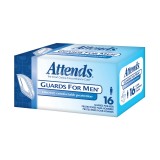
Incontinence pads for men, or male guards, can help protect against dribbling after urination, especially caused by prostate cancer surgery. Similar to gender-neutral pads, male guards adhere to the user’s own underwear. However, guards differ from unisex incontinence pads in that they are “V”-shaped rather than long and narrow. With this design, guards conform to the male body so that men are protected where they need it most.
Many men enjoy the Tena Guards due to its anatomical design with a wide backing and tapered bottom. These guards also feature elastic leg barriers to protect against leakage. Another popular option are the Prevail Guards, one of the most absorbent guards, holding up to 8 oz. of fluid. These discreet guards have an advanced design that wicks liquid away from the skin to prevent infections and irritations caused by urine.
Guards for men are convenient because they’re discreet and disposable, making them easy to use and replace. However, the best the thing about male guards are that they restore confidence in those who experience a loss of bladder control.

Incontinence Products for Men
In addition to male guards, there are a variety of incontinence protection just for men, including protective underwear and adult briefs. Manufacturers, nowadays, are catering to the needs of the male and female body with gender-specific products. This means that incontinence underwear for men look and feel more like regular men’s underwear and protect men where they need it most.
Protective underwear provide a sense of dignity because they are pulled up and down like regular underwear. They’re best for men who are ambulatory and don’t need help changing. Some of the more popular protective underwear include Tena Underwear for Men and Depend Real Fit. Both products feature a highly absorbent core and a soft, cloth-like fabric for maximum comfort and discretion. If you’re looking for something more environmental-friendly, washable pants are another discreet option designed for nighttime incontinence. This machine-washable product can absorb 8 oz. of fluid, but with an added booster pad that fits into its built-in pocket, the waterproof briefs can absorb an additional 9 oz.
For those who suffer from severe incontinence or need assistance getting to the bathroom, disposable adult briefs, commonly known as adult diapers, are your best bet. They come with refastenable tabs for easy removal while sitting, standing, or lying down. Many briefs also feature a wetness indicator stripe to indicate when a changing is needed and advanced technology designed to keep the user dry, odor-free, and less at risk for skin infections.
Incontinence products come in different sizes, styles, and absorbencies, so make sure to keep those features in mind when choosing a product. With the abundance of incontinence supplies available, be rest assured that you can find a product that fits all your needs.

Kegel Exercises for Men
People generally associate pelvic floor exercises, or kegel exercises, with women. However, men can benefit from these exercises too!
First, locate your pelvic floor muscles by stopping your urine midstream or tightening the muscles that keep you from passing gas. These are the muscles you’ll use to perform kegel exercises.
Next, completely empty your bladder and comfortably lie on your back with your knees bent and apart. Tighten your pelvic floor muscles, and hold this contraction for three seconds. Now, relax for three seconds, and then do the same process again at least 10 times in a row, three times a day.
When contracting your pelvic floor muscles, you want to make sure you’re not also tightening your abdominal, thigh, or any other muscles. As your muscles get stronger, try performing the exercises while standing or walking to boost your workout. It’s best to make kegels a part of your daily routine – this means you can do them while cooking, watching TV or sitting in traffic. Not only can kegels improve bladder control, but it can also create lasting erections and enhance sexual pleasure.